I think we can safely say that Spring has arrived in Paris – it’s sunny and warm, and I’m currently having to resist the urge to hang out of my window to get my daily Vitamin D (trust me, I’d be outside if I didn’t have work to complete). In celebration of the arrival of printemps here in the city, I’ve compiled a list of my personal favourite places to lap up the sunshine and the good weather.
Terrasse du Printemps:
The terrace cafe, Deli-cieux, on the 9th floor of the Printemps department store gives you some stunning 360 degree panoramic views of the city. You can see far and wide and truly take in the breathtaking view. The cafe itself has something for everyone, on every budget. You can choose to indulge in some pastries, sandwiches (a jambon-buerre is 8€) or ice cream – or you can just sit back with a glass of wine and relax in the roof-top garden.
You can find it at: 64 Boulevard Haussman, 75009 (M – Havre Caumartin, Opera)
Parc des Buttes-Chaumont:
Buttes-Chaumont is the 3rd largest park in the city and is loved by Parisians, yet rather unknown to visitors. The park is probably most known for its temple folly a-top a rocky island in the middle of the lake. It’s here that stunning views of the city are found, and you truly feel transported out of Paris – that is, until you see the Sacre-Coeur in the distance! With rope bridges, man-made cascading waterfalls, secret nooks and crannies and a beautiful lake, this park offers something for everyone. There’s the chance to explore, relax, walk around, picnic or just enjoy the sun.
Parc des Buttes-Chaumont, 75019 (M – Buttes-Chaumont, Botzaris)
Grande Mosquee de Paris:
The Grand Mosque in Paris is a favourite place of mine, any time of year. Whenever people pay me a visit in the city, I always include a trip because it’s so peaceful and everyone loves it. The cafe offers the chance to sit either in the terrace at the front or in a semi-covered bird garden at the back, both are comfortable and offer the perfect amount of shade vs sun. The traditional drink to sample is their mint tea, which at 2€ a glass is definitely a bargain, but there’s also turkish coffee and other drinks available. There’s the possibility to buy traditional pastries such as baklava and fig rolls and there’s a restaurant where main meals are served if that takes your fancy. In the bird garden there’s a tiny shop selling arabic produce and postcards. Another reason to go, if you need one, is that the mosque is located right next door to Jardin des Plantes, so you can continue your day by exploring and discovering all that has to offer.
Grande Mosquee de Paris, 2 bis, place du Puits-de-l’Ermite, 75005 (M – Jussieu, Censier-Daubenton, Place Monge)
Jardin des Tuileries:
I can’t write a post about spring time and my favourite places without including the best place to lap up the sunshine in my arrondisement. The Tuileries may be overcrowded and a hub for tourists, but with good reason! There’s the chance to sit next to one of the fountains and watch children (and sometimes adults) race toy boats, indulge in some sunbathing, lounge on the grass or watch people play boules or petanque. Being sandwiched in between the Louvre and Concorde, and right next to the Seine and rue de Rivoli, it’s ideal if you’ve been sightseeing and just need to take a breather. There’s Jeu de Paume and l’Orangerie too if you need something else to pique your interest. The children’s playarea is one of the best in the city, and there’s even a rather cheap carrousel. There are many many gardens in Paris, but none will ever beat les Tuileries for me.
Le Jardin des Tuileries, 113 rue de Rivoli, 75001 (M – Tuileries, Concorde, Palais-Royal Musee du Louvre)

Boulevard de Clichy, Pigalle
La Nuit Blanche
StandardSo, last night here in Paris was La Nuit Blanche, which is where everything stays open all night and special installations and exhibits are put up throughout the city. It’s always a fun night, my flatmates and I stuck to the Marais-based events and had a great time!Here’s what we experienced:
Caught by Umeå (L’Institut Suedois):
A temporary space at the Swedish Institute invited us to discover the spirit and culture of Umeå, a city in northern Sweden, which is the 2014 European Capital of Culture. The exhibit itself is touring, with Paris as one of 8 locations it’s visiting. It included photo and design exhibitions, ice sculptures, light and sound. The garden of the Institute was filled with ice sculptures placed around and alight with colour. One of the highlights was seeing a supervisor emerge with a chainsaw to cut some ice from one of the sculptures so the children who were there could play with it. The tour is due to continue on towards Barcelona and Hamburg, and you can find out more here.


Galerie du jour agnès b.:
This was simply a gallery nocture at Galerie du jour agnès b. which kept its doors open for the entire night. The gallery opened in 1984 as a home for contemporary art. There are roughly 10 rotating exhibits a year, showcasing the work of lesser known painters, sketchers, sculpters and photographers. Not having ever had much experience with contemporary art much of the contents seemed to go over my head, to some extent. It still an enjoyable visit, nonetheless. You can find out more information about the gallery here.


Bibliothèque Forney, Hôtel de Sens:
The installation here was named ‘Haute Couture, Haute Tension’ and was set in the medieval-esque backdrop of Hotel de Sens. It focused on the work of artist Elena Paroucheva, and featured three main aspects – a large pylon-cum-dress outfit, a video projection showing Paroucheva’s work and acoustic live entertainment. It was sweet, if a little creepy.

Les Archives Nationales and Le Credit Municipal:
This was a personal highlight, and a good event to finish on! The project was based on the idea of the Mount of Olympus and its garden. Les Archives Nationales became the entrance to the City of the Gods, guarded by mythical beings. Once you progressed through here you were led towards Le Credit Municipal, which was the garden, featuring light-up trees, fountains, UV lights and eerie/fairy-esque/mythical music played in the background to add to the atmosphere.


My OMO
StandardToday my flatmate and I stumbled upon one of the most ingenious pop-up shops we’ve seen. The laundry detergent brand OMO are currently running a shop called ‘My OMO’ at La Cremerie de Paris, 15 rue Les Halles, 75001.
Once you enter you immediately feel transported to somewhere other than Paris, there’s a tropical feeling to the place, and of course, you’re hit almost straight away by that lovely smell of clean clothing. The shop is divided into several steps:
- You’re given a badge (this will become your best friend for the time you’re there) and asked to sign in on Facebook on either a tablet or one of the computer stands – don’t worry, the friendly staff are there with you every step of the way!
- Next, you pay. It’s only 4€ for 28 washes worth of product (1 litre) – a bargain when OMO usually costs 5-7€ in the shops for the same amount.
- Following this you decide a message to write on your bottle, up to 12 characters and the colour of decoration on the front you’d like – there’s 5 to choose from. I chose to have pink flowers and, boringly, the text ‘Michelle’
- Then it’s time to choose the colour of liquid you’d like. Once again you’ve got 5 to select from – mine’s red.
- This is where it gets a bit more fun! Now you have to take a quiz which ascertains your ‘scent profile’ – there are four questions, including: If you were an element, what would be?, and, What kind of music would you be?
- You’re given a title of a scent area then, and once you reach it are presented with 5 different ‘sub-scents’. You proceed to select one of these, which is the scent your washing detergent will be – I chose ‘Fleurs de cerisiers et jasmin’ (cherry blossom and jasmin).
- Next is selecting the colour of your bottle cap – some colours which are not usually available, such as gold! (I opted for pink)
- Then you go downstairs where your bottle is waiting for you in a pink OMO canvas bag with a measuring cup.
Once downstairs you also have to option of a photo with Bubble Man, the OMO mascot, which is then shared on your facebook page.
All in all, it’s a great, fun activity to do and gives you something different to enjoy! And, for the bargainous price of 4€ there are no complaints to be had!


Le Louvre et son Pyramide
Circuits Bijoux: Dans la Ligne de Mire Expo (Les Arts Decoratifs)
StandardAs part of the current Circuits Bijoux event in Paris (Sept 2013 – March 2014) Les Arts Decoratifs are running a new expo, entitled: ‘Dans la Ligne de Mire: Scènes du bijou contemporain en France’. It offers visitors a unique panorama of the most original creations in French contemporary jewellery. The expo takes the form of a series of presentations embedded in the museum’s current permanent collections, with a separate small area dedicated to the ‘Bijoux de Combat / Bijoux de Parade’ special presentation which presents jewellery with an ‘underground’ feel to it.
The expo focuses on contemporary independent jewellery creators rather than established commercial brands, highlighting the work of 50 emerging or established creators. Many are little known to the general public as the generally produce one-off handmade pieces shown in only specialised galleries without much media or critical coverage. These jeweller-artists have a conceptual rather than commercial attitude to their work, rejecting the conventions of classical jewellery and striving for their creations to be regarded as contemporary artworks.
The expo also highlights the creativity in the fashion jewellery field, historically one of the key activities of France’s luxury industries: work by prestigious workshops for haute couture houses, but also creations by independent artisan-jewellers bringing their dazzling techniques and sense of the spectacular to a field in which tradition and innovation have to cohabit. Several exceptional pieces of contemporary jewellery were also selected as examples of another influential and radically changing ‘French tradition.’
The pieces are placed amongst the museums current collection, meaning you have the opportunity to enjoy both the museum itself and the expo. The jewellery is placed well in rooms, keeping in theme and avoiding overbearing and distracting from the artefacts and displays which Les Arts Decoratifs usually showcase. Each of the special insertions is marked by a hot-pink band which explains the artist and significance of the piece.
Here are my top 5 pieces in the main expo:


There is also a small section which Lanvin has decorated with the theme ‘Fashion Decadence’:


Now, the small area dedicated to ‘Bijoux de Combat / Bijoux de Parade‘ is filled with large, extreme, aggressive jewellery. It truly is one of the most fascinating parts of the Circuits de Bijoux event:


All in all, Les Arts Decoratifs is worth a visit in itself, but with added Bijoux expo it’s an opportunity you simply cannot turn down. Cheaper than it’s neighbour The Louvre, offering expos included in all ticket prices (which means they’re free if you fit the usual criteria!) and presenting a wide array of interesting pieces spanning from the Medieval Era to the early 2000s, I implore you to go whenever you get the chance!
Now, I’ll bid you farewell with one final picture from the expo – some lovely vintage couture Chanel!

An English Girl Lost in Paris’ Guide to The Islands
StandardTwo islands in the Seine – Île de la Cité and Île Saint-Louis – are at the heart of Paris’ 2000 year history. It was here that a Celtic tribe called the Parisii established a fishing village that evolved into a strategic Roman town, which in turn became the seat of the French kings and a hotbed of the Revolution. That bygone vibe endures in the Gothic churches, the flower market, the narrow streets of Île Saint-Louis, and the cloisters quartier beside Notre-Dame, where the 21st-century only seems like a distant dream.
Square du Vert-Galant – The square punctuates the downstream end of Île de la Cité, forming one of the two corners of the island. Reached via stairs taking you below street level, this leafy park is the only part of the island that lies at the original water level. The square is named after King Herni IV – dubbed Vert Galant due to his casanova-esque reputation – whose statue stands at the top of the steps. There are several legends that surround the square – it’s said that the large tree near the park’s western end is the first to bloom in Spring. Jacques de Molay was also burned at the stake here in 1314, however it is said that before his death he cursed his persecutors Pope Clement V and King Philip IV. Spookily, both were dead within months of Molay’s execution.

Pont Neuf – Despite the name meaning ‘New Bridge’, this is the oldest of the city’s Seine bridges. Construction finished in 1607, and despite renovations, it looks pretty much identical to 400 years ago. There are 7 arches on the north side of the island and five on the south, decorated with gargoyles and other grotesques.

La Conciergerie – In the midst of the French Revolution, the Reign of Terror (1793-4) reached its cruelest extreme inside this notorious prison on the north-side of Île de la Cité. Originally part of a medieval royal palace, it was converted into a prison in the late 14th century. By the late 18th century thousands of people were being tried, tortured and detained inside its walls, waiting to be executed at Place de la Concorde. Marie-Antoinette spent several months imprisoned here before she was guillotined. Robespierre and Danton were also later kept here before their respective executions. The Chapelle des Girondins – where 22 revolutionaries spent their last night dancing round the body of a dead comrade – is now a museum displaying Marie-Antoinette’s crucifix and a guillotine blade, among other items.

Sainte-Chapelle – This former royal chapel is an astonishing and breathtaking remnant from Paris’ medieval period. It was comissioned by Louis IX in the mid-13th century to house holy relics that he had collected during the Crusades – these relics are now housed at Notre-Dame de Paris. Along with La Conciergerie the church is all that remains of the original Palais de la Cité, a former royal palace. The design is a mix of flying buttresses, sumptuous woodwork and dazzling ceilings. Strangely, Sainte-Chapelle is in fact two chapels – La Chapelle Basse and La Chapelle Hausse, with the lower chapel serving as the foundation and support for the upper chapel. It’s for this reason the upper chapel is much more open and decadent. Original 13th-century stained glass windows with 1100 intricate biblical scenes transform the upper chapel into the breathtaking marvel it is. Sainte-Chapelle is enclosed within the Palais de Justice, a complex of 19th-century buildings that house Paris’ highest law courts. La Conciergerie and Sainte-Chapelle tend to come as a pairing, as they are practically next to each other on Boulevard du Palais – for this reason, the cheapest option for tickets is to purchase a twinned-ticket permitting you to access both at a slight discount.

Place Louis Lépine – Named after a former police chief, due to its proximity to La Préfecture de Police du 1ère arr. this small square offers a splash of colour admist the legal buildings that dominate this part of the Island. Tuesday through to Saturday it plays host to a fragrant flower market. On Sundays, however, the square morphs from a marché aux fleurs, into a marché aux oiseaux specialising in a variety of tropical, exotic and colourful birds and birdcages.

Cathédrale de Notre-Dame de Paris – Built between 1163 and 1345 Notre-Dame is one of few buildings that can be described as both an architectural landmark and a cultural icon. Looming over Place du Parvis Notre-Dame, the cathedral façade is one of the great works of Gothic artistry, with the rose window taking pride of place and forming a halo around the Virgin and Child. The cathedral is, by all definitions, massive. The core is 427ft (130m) long and 115ft (35m) high, flanked by 37 chapels and 75 giant stone pillars. More than 9000 people can fit inside the building for worship. The massive rose windows and their glass bays are as tall as six storey building. I’ve had the immense pleasure of singing in the Cathedral for the Remembrance Day service with my choir. I have to admit that at some points there seemed to be thousands of people watching, and there probably was. It was one of those times when you had to pinch yourself to truly believe what was happening!
The twin belltowers rise 226ft (69m) into the sky. It is possible to access them from the bottom of the North Tower – don’t be put off by the length of the queue. It may seem like it will take for ever, but rather efficiently the staff allow 20 people to enter every 10 minutes, I spent roughly an hour queuing, but I read and the time whittled away. There are 400 steps up in total, with no space for respite during the climb and only stair access (i.e. no elevator). Yoiu first reach the Chimera Gallery on the North Tower where you are at the same level as the gargoyles and have the possibility to view the Emmanuel Bell (be warned – the bell is not always on view, it’s currently closed for improvement works). Next you proceed to the panoramic view atop the South Tower. This is the highest point of the cathedral and gives stunning views of the entire city, especially on a sunny day like today was. Viewing time here, however is limited to 5 minutes.


Ancien Cloître Quarter – This quartier filled with lanes on the north side of Notre-Dame recalls the medieval landscape that once covered much of central Paris. Streets in the Ancient Cloister Quarter, such as rue des Ursins and rue de la Colombe, evoke the time when monks occupied this area. Rue Chanoinesse is flanked by ancient clergyman’s houses, as well a newer building (no. 10) where the tragic 12th-century love affair between Ablélard and Héloïse allegedly played out.

Île Saint-Louis – The little Île Saint-Louis is oft overlooked by tourists, but is a favourite haunt of Parisians. Originally used for grazing cattle, the marshy island was transformed in the 17th century into an artistocratic enclave where many members of the Enlightenment lived, worked and played. Hôtel de Lauzun and the island’s church Saint-Louis-en-Île are worth a visit, but the most Parisian thing you can do? Go buy an ice cream at Berthillon and descend the steps to the river’s edge and relax a little.


If you want to do these activities in one day, the beginning métro is Pont-Neuf (Line 7), ending at Pont Marie (Line 7) and is roughly 1.8 miles
An English Girl Lost in Paris’ Guide to Saint-Germain and Montparnasse
StandardAn artistic flair still prevails in Saint-Germain and Montparnasse, which strech from the south of the Seine to Cimetière du Montparnasse, whose tombstones include many intellectuals and philosophers who once visited the cafes and gardens of the quartiers. Today, Saint-Germain is known more for its high-end upmarket boutiques and restaurants, with Montparnasse being the business district within the city limits. Nonetheless, you can still feel the artistic current that runs throughout.
Musée Delacroix – The artist Eugène Delacroix moved to Rue de Furstemberg in Saint-Germain in 1857 to work on murals painted in Église Saint-Sulpice. The museum became a national site 1971 and includes Delacroix’s studio, apartment and private garden. The museum is linked with the Louvre, meaning it’s possible to buy a joint ticket for both sites. The museum is small, but is packed to the brim with Delacroix’s work. The garden is also beautiful, and would be the perfect place to relax for a while, read a book or have a bite to eat.


Église Saint-Germain-des-Prés – Founded in 542, Paris’ oldest church was once part of a powerful and rich abbey. The current building, dating from the 11th-century, retains some of its 6th-century columns. The abbey closed during the Revolution after a mob stormed its prison during the September Massacres, when many suspected countre-revolutionaries were killed. Gunpowder was later stored in the abbey, which exploded in 1794, destroying many of its buildings; the church was heavily restored in the 19th-century. The dimly lit building holds the tomb of René Descartes, the father of modern philosophy

Église Saint-Sulpice – The building of Paris’ second largest church, after Notre Dame de Paris, began in 1646 and took more than 100 years. Three Eugène Delacroix murals (Lutte de Jacob avec l’Ange, Saint-Michel terrassant le Dragon, and, Héliodore chassé du Temple) adorn the chapel to the right of the door. The church also houses one of the city’s largest organs, whose 6588 pipes fill the air with music in concerts held post-mass on Sundays.

Grande Épicerie de Paris – This mammoth-sized food market will definitely leave you feeling hungrier than when you came in. 20 bakers and 25 pastry chefs produce fresh croissants, 70 speciality breads, artistic éclairs, petit fours and dozens of other pastries fresh every morning. There is also hot and cold international cuisine, 57 types of bottled water, dozens of olive oils, and hundreds of cheeses… And don’t get me started on the wine cellar…

Jardin du Luxembourg – This 60-acre oasis of greenery adjacent to Paris’ Senate is probably the city’s favourite park. It was constructed in the early 17th-century to replicate Queen Marie’s childhood home in Florence. Today, the park is full of elm trees, apple and pear orchards and flower beds, with statues scattered throughout. The park is full to the brim with activity, whether its puppet shows, pony rides, model boat sailing or boules you’re after!

Musée Zadkine – Around 300 sculptures from artist Ossip Zadkine are on display at his former cottage home on Rue d’Assas. The Russian sculptor gained an international reputation for his cubist inspired works. The garden is full of miniatures of his sculptures, whilst Gallery Two holds a collection of his more famous cubist-creations. Gallery Four, on the other hand, focuses on the medium of wood and takes you step-by-step through his career. The museum is free to all.

Cimetière du Montparnasse – In 1824 three farms were combined to create what became one of Paris’ most famous cemeteries. The 47-acre cemetery is home to more than 300,000 graves, including many of Paris’ philosophical thinkers. There are free maps available just inside the entrance, so you can save time wandering and find graves that you specifically want to see. The most natable names are probably – Sartre, de Beauvoir, Baudelaire, Sontag and Samuel Beckett the Irish playwright.

Tour Montparnasse – 690 metres and Paris’ most-hated building, Tour Montparnasse, offers stunning view of the city. It’s the tallest building within the city confines and is regularly the bane of Parisian’s life as it’s an eyesore that ruins the city skyline – their view, not mine. The 56th floor provides stunning views across the city both day and night, with interactive displays and videos. It’s the perfect place for a panoramic view of Paris. Most people advise you to go to the Eifeel Tower, but what’s a Parisian city skyline without its crowning jewel?

If you decide to walk this, it is roughly 4 miles in length and begins at Saint-Germain-des-Près métro (Line 4), ending at Montparnasse-Bienvenüe (Lines 4, 12 and 13).
An English Girl Lost in Paris’ Guide to Montmartre
StandardPerched on a hilltop, known as La Butte, Montmartre in northern Paris has always stood apart from the rest of the city. It captures the essenece of old, traditional Paris like no other quartier. Walking through the streets you can’t help but imagine the artists who previously (and still do) flocked here to make their living, in the area of the city synonymous with bohemian living.
Here’s my guide of how to get the best out of the quartier in one day:
Basilique de Sacré-Cœur – This church was built to symbolise the return of France’s self-confidence after its defeat in the 1871 Franco-Prussian War. It was built atop the hill, as it is said that Saint-Denis (the city’s patron saint) was martyred in that exact spot. Construction began in 1875 and took 39-years to build. The church is built from tavertine, a type of limestone that bleaches with age, so it permanently retains its white façade. It’s possible to climb to the top of the dome, for a stunning view of Paris, however the view from the foot of the church is just as breathtaking – if you’ve ever seen the film Amélie, you probably remember a scene where she looks at a view through binoculars, that’s from the foot of the Sacré-Cœur. You can also venture down into the crypts. I’ve only ever visited them once, and I was one of the only people down there, and it was rather eerie. I advise you to bear in mind that when climbing the dome, there are no lifts, merely steps.

Saint-Pierre de Montmartre – Dwarfed by the Sacré-Cœur, St-Pierre is in no way opulent or grand, but is still worth a peek. It is Paris’ second oldest church and all that remains of Montmartre’s Benedictine Abbey, founded by Louis VI and his wife Adélaïde de Savoie in 1133. The last abbess was guillotined during the Revolution and the abby closed, not reopening again until 1908. Whilst many renovations have taken place, there are still several original features – the 12th century vaulted choir and four marble columns that are said to come from a Roman temple. If you so happen to be there on 1st November the graveyard is open on this day only, and contains the graves of several key players in Parisian history.

Place du Tertre – This is seen as the heart of bohemian Paris, and is also known as The Artists’ Square. Artists including Monet, Renoir and Picasso all once painted in this very spot. The sqaure is full of street artists, who’ll willingly paint or sketch for you, expensive cafes and many tourists. Some of the original bohemian magic still remains nonetheless – La Mère Catherine is regarded as Paris’ oldest bistro, no. 21 was the home of the Montmartre Free Commune, founded in 1920 to preserve the free-thinking in the area. A number of eccentric policies were suggested by the Commune, including the banning of December, January and February and a limitation on the number of tourists in the area. Ironically, the building now houses the tourist office.

Musée de Montmartre – The showcase of Montmartre’s cultural and historical life is located in this 17th-century manor house – the oldest in the quartier. From 1875 onwards it was converted into studios used by artists such as Renoir, Dufy, Utrillo and Valadon. The lower floors display the history of Montmartre through the revolutions and wars, while the upper floors are dedicated to the hedonistic days of the city’s artistic life. The very top of the building is still used as studios, so don’t be surprised if you see someone painting away in the window when you’re in the gardens! The gardens themselves are beautiful, renovated in 2012 they have been made to look as similar to Renoir’s paintings of the area as possible. There is also the minature forest which is off-limits to everybody but cats. The manor house is perfectly positioned to see the vineyard of Montmartre. While you’re in the museum, it’s a little bit like you’re not in Paris anymore and could be anywhere else in the country.


Avenue Junot – A century ago Avenue Junot was overgrown and inhabited by vagrants, but that’s not the reason you should visit it. It’s the epitome of chic in the 18ème, and has earned the nickname Le Champs-Élysées de Montmartre. The broad, tree-lined avenue is home to the elite of Montmartre in between private artists’ studios. Several houses to take note of – no. 13 is the former home of illustrator Francisque Poulbot and is covered in mosaics of his drawings, no. 15 is the cubist home of Tristan Tzara, designed by Adolf Loos, and no. 23 bis is a group of fairy-tale art deco houses with beautiful gardens.

Moulin de la Galette – One of Montmartre’s two remaining wooden windmills (once there were 14), Moulin de la Galette on Rue Lepic was built in 1622, when it was known as Blute-fin. Originally it was simply used to press grapes and grind grain, until the 19th-century when the Debray family bought it and used it to make galette, a common type of French rye bread. The bread, which is customarily served with a glass of milk, became so popular that the mill’s name was changed. Over the years the Debray’s changed the milk to wine and added a dance hall, which soon became the centre of the Parisian social scene. It was immortalised by van Gogh and Renoir, whose painting Dance at Le Moulin de la Galette hangs in Musée d’Orsay. Unfortunately the windmill is closed to the public, but just round the corner is Moulin Radet, another mill once owned by the same family, which towers above the restaurant Moulin de la Galette.

Musée Gustave Moreau – This museum is rarely visited, but boasts a vast collection dedicated to the works of painter Gustave Moreau (1825-98). There 1000 of his own paintings and 7000 drawings and many of his unfinished sketches. The gallery is in the building which Moreau shared with his parents, which he designed in his own way to be able to showcase his works in the best possible manner. You can also see the family’s small apartment rooms which are crammed to the brim with personal belongings and furniture. Moreau’s study and book collection are also able to be viewed.
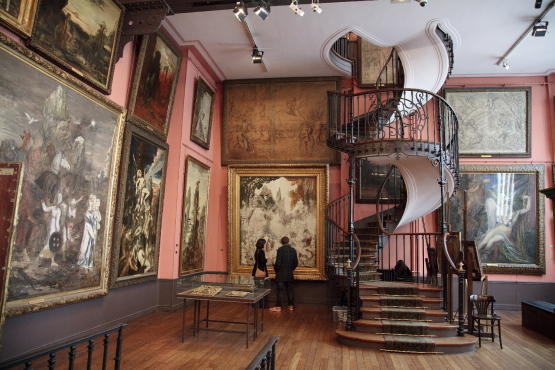
So, that completes my idea of the perfect Montmartre-based day! It’s walkable, however there are metro stations scattered throughout. The walk is roughly 2 miles, and if you spend your time at each area, it can take up to 7 hours. It begins at Anvers métro (Line 2), finishing at Saint-Georges métro (Line 12).
L’Art Nouveau: La Revolution Decoratif Expo (La Pinacotheque)
StandardLa Pinacothèque de Paris is an art gallery at Place de la Madeleine, which holds temporary expos.
It was opened on 15th June 2007 in its current home of Place de la Madeleine, after being primarily installed at Rue de Paardis in the 10ème. The gallery is entirely funded from private sources and organises expos throughout the year, as there is no permanent collection of exhibits.
Currently the gallery is focusing on the Art Nouveau movement of the 1920s. I opted to visit one of the expos currently ongoing – L’Art Nouveau: La Revolution Decoratif, which is being held at Pinacotheque 1. The expo features furnishings, paintings, posters, etc. and includes examples of all the major aspects to the creation of l’Art Nouveau.
The expo is running until 8th September 2013, and the tickets start at 12€


